Choosing the right types of soccer training equipment is genuinely confusing. Walk into any sporting goods store or scroll through an online catalog and you will find dozens of products promising faster feet, better first touch, and sharper finishing. Not all of them deliver equal value, and buying the wrong gear wastes money and training time. This guide breaks down every major category of soccer training gear, explains what each tool actually develops, and gives you the cost and durability information you need to build a home soccer training equipment list that matches your player’s age, goals, and budget.
Table of Contents
- Criteria for choosing soccer training equipment
- Essential soccer training equipment explained
- Footwear and protective gear for effective training
- Advanced training tools and efficiency boosters
- Comparison of popular soccer training equipment types
- Our perspective: the equipment trap most families fall into
- Take your training further with Soccercademy
- Frequently asked questions
Key Takeaways
| Point | Details |
|---|---|
| Start with basics | Begin training with affordable, foundational equipment like a ball and cones before buying advanced tools. |
| Match cleats to surface | Choose soccer cleats based on whether you play mostly on natural grass, turf, or both to optimize performance and safety. |
| Use rebounders for solo practice | Rebounders uniquely simulate passing and improve first touch, making them invaluable for solo skill drills. |
| Balance speed training tools | Combine resistance bands and speed hurdles while alternating to avoid muscle imbalances and maximize acceleration. |
| Protect yourself properly | Always wear fitted shin guards and appropriate socks to prevent injury during training and games. |
Criteria for choosing soccer training equipment
Now that you understand the selection challenge, let’s explore key factors that should drive every purchase decision before you spend a dollar on soccer practice accessories.
Training goals come first. A player working on dribbling needs cones and a ball. A player focused on finishing needs a portable goal and a target net. Buying a rebounder before mastering basic ball control is like buying a treadmill before learning to walk. Identify the specific skill gap, then match the tool to it. You can develop soccer skills effectively by working backward from your weakest area rather than buying what looks impressive.
Player age shapes equipment size and complexity. Youth players under age 10 benefit most from simple, tactile tools: size 3 or 4 balls, low-profile cones, and short agility ladders with wide rungs. Adolescent players aged 13 and older can productively use resistance bands and speed hurdles, which demand neuromuscular (nerve-to-muscle) coordination that younger players have not yet fully developed.
Key selection criteria to evaluate before any purchase:
- Training goal alignment: Match each tool to a specific skill: dribbling, passing, shooting, footwork, or conditioning.
- Age and physical readiness: Younger players need simpler tools; advanced equipment requires baseline strength and coordination.
- Playing surface: Grass, turf, and indoor surfaces each demand different footwear and affect how equipment like rebounders and cones perform.
- Budget discipline: Start with foundational gear (ball, cones, shin guards) before adding specialized tools.
- Durability and weather resistance: Outdoor equipment must withstand UV exposure, moisture, and repeated impact to provide consistent long-term value.
For players also working on physical conditioning, soccer strength training tips can help you understand how equipment choices connect to athletic development at each stage.
Essential soccer training equipment explained
Let’s examine the staple items every soccer player should consider adding to their training kit. These four categories form the foundation of any effective home or practice setup.
Disc cones are the most versatile and underrated item on any home soccer training equipment list. A standard pack of 50 cones costs between $10 and $25 and can be configured into dribbling gates, boundary grids, passing channels, and agility courses within minutes. Because they are flat, they do not cause ankle injuries when stepped on, which matters during high-speed footwork drills.
Rebounders are the closest thing to a training partner when no one else is available. A quality rebounder costs between $60 and $200 and returns the ball at a realistic angle, forcing the player to control an unpredictable touch rather than a perfectly served pass. This directly trains the first-touch mechanics that separate technical players from average ones. Agility ladders at $15 to $30 improve footwork and coordination, with consistent use shown to improve reaction time by up to 20%.
Portable pop-up goals give players a target for finishing drills in the backyard without requiring permanent installation. They fold flat for storage and typically cost $30 to $80 depending on size and frame material.
Essential equipment at a glance:
- Disc cones ($10-$25 per pack): Dribbling courses, boundary markers, agility grids
- Rebounders ($60-$200): Solo passing, first touch, receiving under pressure
- Agility ladders ($15-$30): Footwork speed, coordination, neuromuscular patterning
- Portable pop-up goals ($30-$80): Finishing drills, shooting accuracy, backyard practice
Pro Tip: Place cones in a 5-yard gate pattern and challenge yourself to dribble through 10 consecutive gates without touching a cone. This single drill builds close control faster than most structured exercises because it forces constant micro-adjustments in foot placement.
When you combine these tools into a single session, you can progress all aspects of your soccer game without needing a full team or a formal practice environment.
Footwear and protective gear for effective training
Understanding vital footwear and protective gear rounds out crucial soccer training essentials. These items are not optional accessories. They directly affect injury risk and training confidence.
Cleats by surface type are the most important equipment decision a family makes. Firm ground (FG) cleats with molded studs cost $50 to $150 and suit approximately 70% of youth fields in the U.S. Multi-ground (MG) hybrid cleats work well for players who split time evenly between grass and artificial turf, reducing slip risk by up to 40% compared to wearing FG cleats on turf.
Shin guards are non-negotiable. Shin guards are required by 100% of U.S. youth leagues, and properly fitted models under $20 protect against direct impacts during both practice and match play. Poorly fitted guards shift during movement and leave the lower shin exposed, which defeats their purpose entirely.
Footwear and protection checklist:
- FG cleats: Best for natural grass fields, molded studs provide stable traction
- MG cleats: Ideal for players training on mixed surfaces, reduces injury from slipping
- AG cleats: Designed specifically for artificial turf, shorter and more densely packed studs
- Shin guards: Required for all youth leagues, fitted models stay in place during sprints
- Knee-high socks: Secure shin guards against the leg and add a layer of abrasion protection
Pro Tip: Replace cleats when the stud height drops below 5mm. Worn studs on wet grass are a leading cause of knee strain in youth players because the foot cannot grip and release the surface correctly during cutting movements.
Footwear also connects directly to physical output. Players wearing appropriate cleats generate more force through the ground during acceleration, which is why strength training for soccer players always accounts for surface-specific footwear when programming sprint and agility work.
Advanced training tools and efficiency boosters
Beyond basics, these advanced tools offer targeted gains for serious players aiming to elevate performance. They are not replacements for foundational equipment but additions that address specific physical and technical qualities.
Resistance bands train sprint acceleration by increasing the force demand on the hip flexors and glutes during the drive phase of sprinting. Resistance bands boost sprint acceleration but must alternate legs to avoid muscle imbalance. When paired with speed hurdles, players can see 15 to 25% quicker stride frequency after just four weeks of consistent training. That is a meaningful gain in a sport where a single step of separation creates a scoring chance.
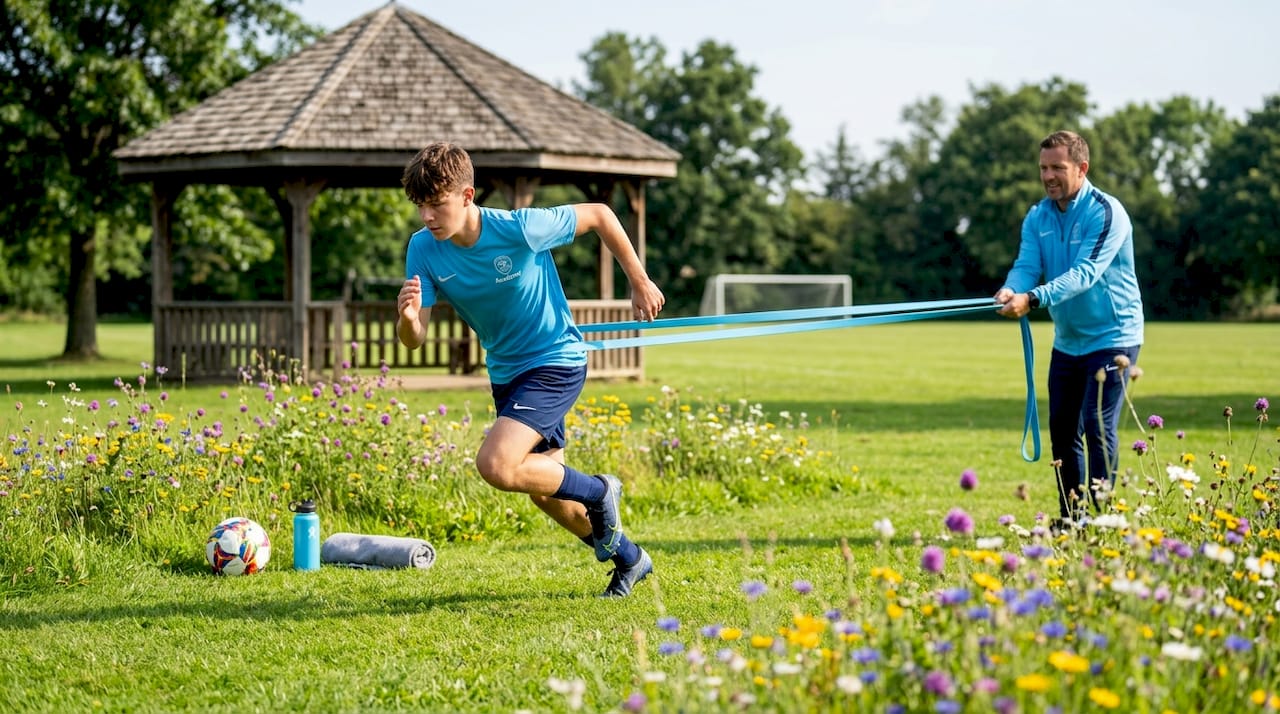
Speed hurdles improve stride mechanics by training the player to lift the knee and drive the foot down quickly, which is the neuromuscular pattern underlying explosive acceleration. Unlike agility ladders, hurdles introduce a vertical clearance demand that activates hip flexors more directly.
5-zone target nets attach to the inside of a standard goal and divide the net into scoring zones. 5-zone target nets cut shooting time by approximately 40% by directing every shot toward a specific corner or low zone, which builds placement accuracy far faster than shooting at an open goal.
Advanced tools summary:
- Resistance bands ($15-$40): Sprint acceleration, hip strength, neuromuscular drive phase training
- Speed hurdles ($20-$50 for a set): Stride mechanics, knee lift, explosive first step
- 5-zone target nets ($25-$60): Shooting placement, finishing efficiency, corner accuracy
- Ball trainers/solo kick trainers ($20-$50): Repetitive striking mechanics without chasing the ball
Pro Tip: When using resistance bands for sprint work, keep the band length short enough that it creates tension within the first two steps. Longer bands only engage resistance mid-stride and miss the acceleration phase entirely, which is where the training benefit lives.
For players serious about speed development, understanding the science behind developing elite soccer speed will help you integrate these tools into a structured program rather than using them randomly.
Comparison of popular soccer training equipment types
To simplify your decision, here is a clear comparison of key training equipment types based on practical factors that matter to players and families.
| Equipment | Cost range | Primary skill | Portability | Durability | Best for |
|---|---|---|---|---|---|
| Disc cones | $10-$25 | Dribbling, agility | Very high | High | All ages |
| Agility ladder | $15-$30 | Footwork, coordination | High | Medium | Ages 8+ |
| Rebounder | $60-$200 | First touch, passing | Medium | High (steel frame) | Ages 10+ |
| Pop-up goal | $30-$80 | Finishing, shooting | High | Medium | All ages |
| Resistance bands | $15-$40 | Sprint acceleration | Very high | Medium | Ages 13+ |
| Speed hurdles | $20-$50 | Stride mechanics | High | High | Ages 12+ |
| 5-zone target net | $25-$60 | Shooting accuracy | Medium | Medium | Ages 10+ |
| Shin guards | Under $20 | Injury prevention | Very high | Medium | All ages |
A few key trade-offs worth noting:
- Rebounders vs. walls: Adjustable-angle rebounders outperform fixed walls for training realistic ball return angles, but they require secure anchoring on grass to prevent rebound inconsistencies.
- Cones vs. poles: Cones are safer at high speed; poles provide better visual reference for dribbling gates but create a tripping hazard for younger players.
- Pop-up goals in heat: Inflatable pop-up goals lose pressure faster in high temperatures, making mesh-frame models more reliable for summer training in warmer climates.
You can find additional soccer training tips and reviews to help you evaluate specific products before purchasing.
Our perspective: the equipment trap most families fall into
The most common mistake we see families make is buying advanced equipment before the player has the foundational repetitions to benefit from it. A $200 rebounder sitting in a garage because a 9-year-old finds it frustrating is not a training investment. It is an expensive obstacle.
The honest truth about what equipment is needed for soccer training is that the answer changes every 12 to 18 months as the player develops. A beginner needs a ball, cones, and proper cleats. Nothing else. Once the player can dribble through a 10-gate cone course consistently and strike the ball with the instep accurately, a rebounder becomes genuinely useful. Once the player can control a rebounder pass and combine it with a finishing move, a target net adds measurable value.
The best soccer drills equipment is the equipment that matches the player’s current skill ceiling, not the ceiling they aspire to reach. Buying ahead of development does not accelerate growth. It creates frustration and abandonment. Start simple, master the basics, then add tools that address a specific and observable weakness. That sequence produces players who actually improve.
Take your training further with Soccercademy
Building the right home soccer training equipment list is only half the equation. Knowing exactly how to use that gear in structured, progressive sessions is what turns equipment into real skill development.
At Soccercademy, we work with soccer athletes in Columbus, Ohio and are expanding our training resources online so players everywhere can access the same structured development programs. Our upcoming membership area will give you on-demand training videos built around the exact youth soccer training tools covered in this guide, from cone drills to rebounder sessions to speed work. Whether you are a player training at home or a parent looking for a clear development path, our programs are designed to make every piece of equipment you own more effective. Explore our training resources and see how structured coaching turns good gear into real results.
Frequently asked questions
What are the most essential soccer training equipment for beginners?
Beginners should start with a soccer ball, disc cones for dribbling, and firm ground cleats matched to their playing surface, adding shin guards for safety. 80% of skill gains come from foundational repetitive drills using a ball and cones before adding rebounders or advanced gear.
How do I choose the right soccer cleats for my child?
Select cleats based on the main playing surface: firm ground (FG) for natural grass, artificial ground (AG) for turf, or multi-ground (MG) for mixed surfaces. FG cleats suit 70% of youth fields, while MG hybrids reduce slip risk by 40% on mixed surfaces.
Can resistance bands improve soccer speed?
Yes, resistance bands improve acceleration when used correctly, with alternating legs weekly to prevent muscle imbalances. Bands paired with hurdles can produce 15 to 25% quicker strides after four weeks of consistent training.
Are pop-up soccer goals suitable for backyard training?
Portable pop-up goals are well-suited for backyard finishing drills and typically cost $30 to $80, though they should be stored in shade. Pop-up goals deflate 20% faster in heat, making shaded storage essential for maintaining consistent air pressure through the training season.
Recommended
- Train your Players to Level Up! – Pavel shows soccer players step by step how to progress all aspects of your soccer game with training and play with the confidence you want on the field
- Why Soccer Players Need Different Strength Training Than Other Athletes – Train your Players to Level Up!
- Dynamic Warm-Up Protocols That Actually Prevent Soccer Injuries – Train your Players to Level Up!
- Evidence-Based Guide to Game-Day Nutrition for Soccer Players – Train your Players to Level Up!