
Key Points
| Best For | Youth players ages 8-16 who want more touches than team practice provides |
| Time Investment | 10-15 minutes per session, 3-5 days a week |
| Key Insight | The wall returns every pass exactly as you hit it — instant, honest feedback no training partner can match |
| What Most Miss | Wall work isn’t about volume — it’s about the receiving touch between passes |
| Coach’s Take | I assign wall drills to every player I train because they compress a hundred game moments into ten minutes |
The wall never gets tired. It never misses a pass, never checks its phone, and never needs a ride to practice. That’s why soccer wall passing drills are the first homework I give every player who trains with me here in Columbus — before ball mastery routines, before shooting work, before anything else.
Here’s what most parents don’t realize: a youth player touches the ball maybe 20-30 times in a full match. In ten minutes against a wall, they’ll get 150+ passes and 150+ receiving touches. No other form of practice comes close to that density. And unlike solo dribbling work, every single rep involves the two skills that decide games at the youth level — the quality of your pass and the quality of your first touch.
I’ve watched players transform their in-game confidence in four to six weeks of consistent wall work. This guide is the exact progression I use: basic patterns, first-touch drills, quick touch speed work, game-realistic combinations, and a weekly plan to put it all together.
Why The Wall Is Your Best Training Partner
Every pass against a wall is really two reps: the pass out and the touch back in. That receiving touch is where the magic happens. Strong soccer ball control isn’t built by dribbling around cones alone — it’s built by receiving a moving ball hundreds of times under slight time pressure, which is exactly what the wall provides.
The wall is also brutally honest. Hit a sloppy pass and you’ll chase the rebound across the yard. Hit a clean, firm pass with good technique and it comes right back to your feet. Players self-correct within minutes because the feedback is immediate and physical. I can coach technique all day, but nothing teaches pass weight like retrieving your own bad passes.
No wall at home? A rebounder does the same job — with the bonus of returning balls at angles and, on the angled models, in the air, which flat walls can’t do. The Rebounder Passing Net in our store is the one I recommend to families; it sets up in a backyard in a couple of minutes. (As an Amazon Associate, Soccercademy earns from qualifying purchases.)
Here’s how the options stack up:
| Wall | Rebounder | Training Partner | |
|---|---|---|---|
| Availability | Any time (garage, school, park) | Any time, at home | Scheduling required |
| Return consistency | Perfect — mirrors your pass | Consistent, adds bounce/angles | Variable |
| Aerial returns | Limited | Yes (angled net) | Yes |
| Feedback quality | Brutally honest | Honest | Depends on partner |
| Cost | Free | ~$80 one-time | Free (but unreliable) |
Use the wall or rebounder for volume during the week, and save partner passing for weekends and team practice.
Basic Wall Passing Patterns: Build The Foundation
Swipe to see all three panels →
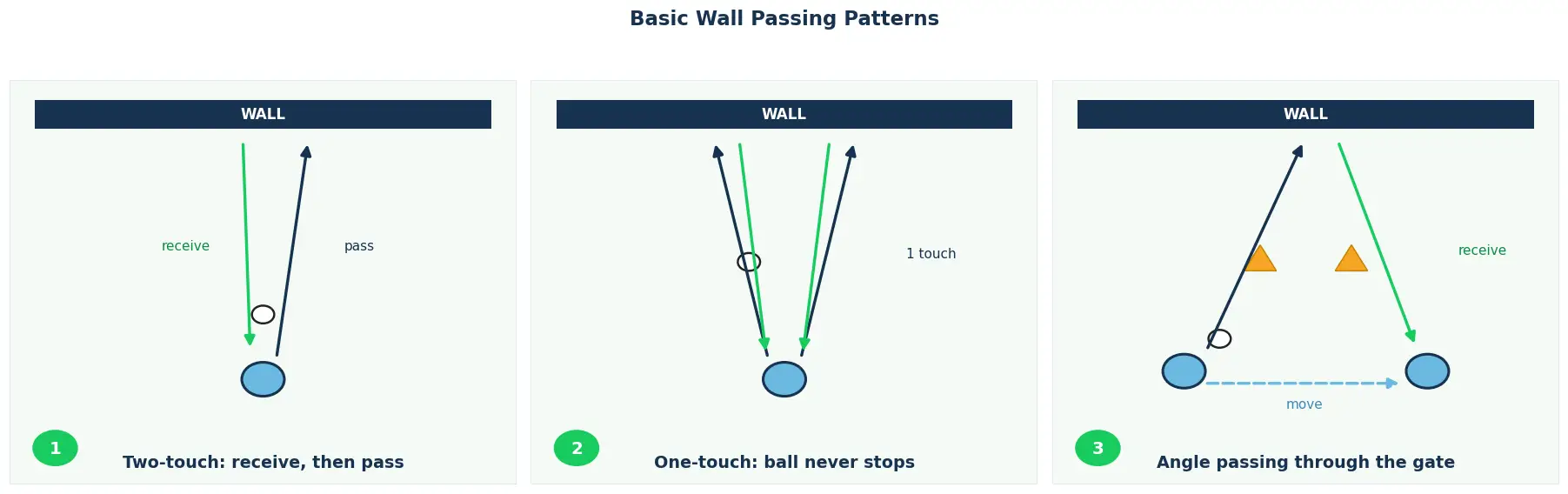
Start every player here, regardless of age. Stand 3-4 yards from the wall.
Two-touch inside foot. Pass with the inside of the right foot, receive with one touch, pass again. 20 reps, then switch to the left. The checkpoint: your receiving touch should set the ball exactly where your next pass wants it — no adjustment touch, no reaching.
One-touch inside foot. Same setup, but the ball never stops. This forces your body to prepare before the ball arrives — ankle locked, body over the ball, eyes reading the rebound. If the rhythm breaks down, you’re standing too far away or passing too hard. Fix the distance, not the effort.
Alternating feet. Pass right, receive left, pass left, receive right. This is the pattern that exposes the weak foot fast, and it’s non-negotiable in my sessions. Youth players who can pass and receive with both feet play like they have twice as many options — because they do.
Angle passing. Set two training cones a yard apart in front of you as a gate, and stand at a 45-degree angle to the wall. Pass through the gate into the wall, move laterally, receive on the other side. Now you’re passing and receiving on the move — which is the only way it happens in a real game.
First Touch And Ball Control Drills On The Wall
Swipe to see all three panels →
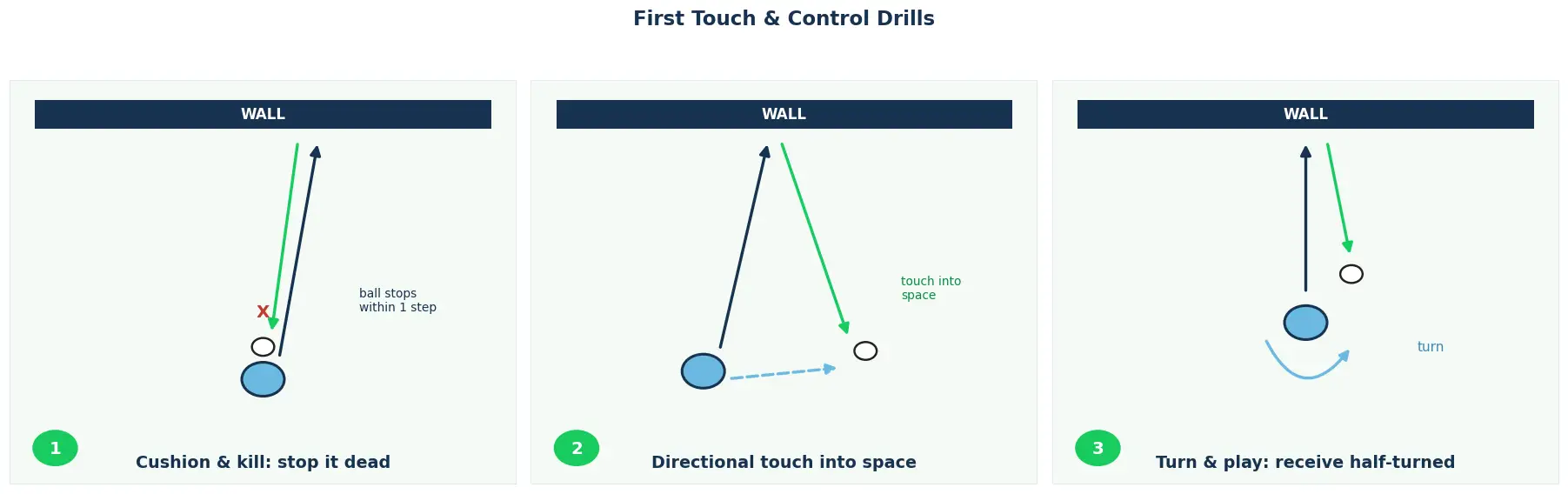
This is where wall work separates itself from every other solo drill. These four build the receiving skills I covered in my ball control guide — but against a live, moving ball.
Cushion and kill. Pass firmly, then deaden the rebound completely with your first touch — inside of foot, then sole, then laces as the difficulty climbs. The ball should stop within one step of your body. This teaches the “soft foot” that lets players receive under pressure without the ball bouncing away.
Directional first touch. Pass, then take your first touch into space — two yards left or right — and play your next pass from there. This is the single most game-transferable drill on this list. Great players don’t stop the ball; they move it toward their next decision with the first touch.
Turn and play. Stand with your back to the wall, toss or backheel the ball against it, then turn, receive, and control. Progress to receiving half-turned — the way midfielders receive in matches. Every touch answers the question defenders force in games: can you turn under pressure?
High-ball control. Throw the ball against the wall above head height and control the rebound out of the air — thigh, chest, or cushioned laces. Most youth players panic when the ball leaves the ground. Ten minutes a week of this fixes that.
Quick Touch Soccer: Speed Drills Against The Wall
Once the patterns are clean, add speed. Quick touch soccer — playing in tight spaces with one and two touches under time pressure — is what club coaches at every Columbus tryout are scanning for, and the wall trains it better than anything short of a live rondo.
Rapid-fire one-touch (30 seconds). Count the passes, rest 30 seconds, repeat 4 rounds, and try to beat your number. Quality rule: a pass that misses your target zone on the wall doesn’t count.
Two-foot rapid alternation. Same 30-second format, but strictly alternating feet. Numbers will drop by a third at first. That gap is your weak-foot deficit — watch it close week over week.
Close-range quick feet. Step in to 1-2 yards from the wall and play sharp one-touch passes with almost no backswing. This mimics tight-space play in the box and crowded midfields. It’s uncomfortable, which is exactly the point.
Check-away and receive. Start 6-7 yards out. Pass, sprint two steps away from the wall, plant, come back toward the rebound, and receive on the half-turn. This is the movement pattern of every good midfielder — check away, check back, receive. Do it 10 times and you’re breathing hard, which tells you something about how much movement good receiving actually requires.
Game-Realistic Patterns And Soccer Practice Games
Swipe to see all three panels →
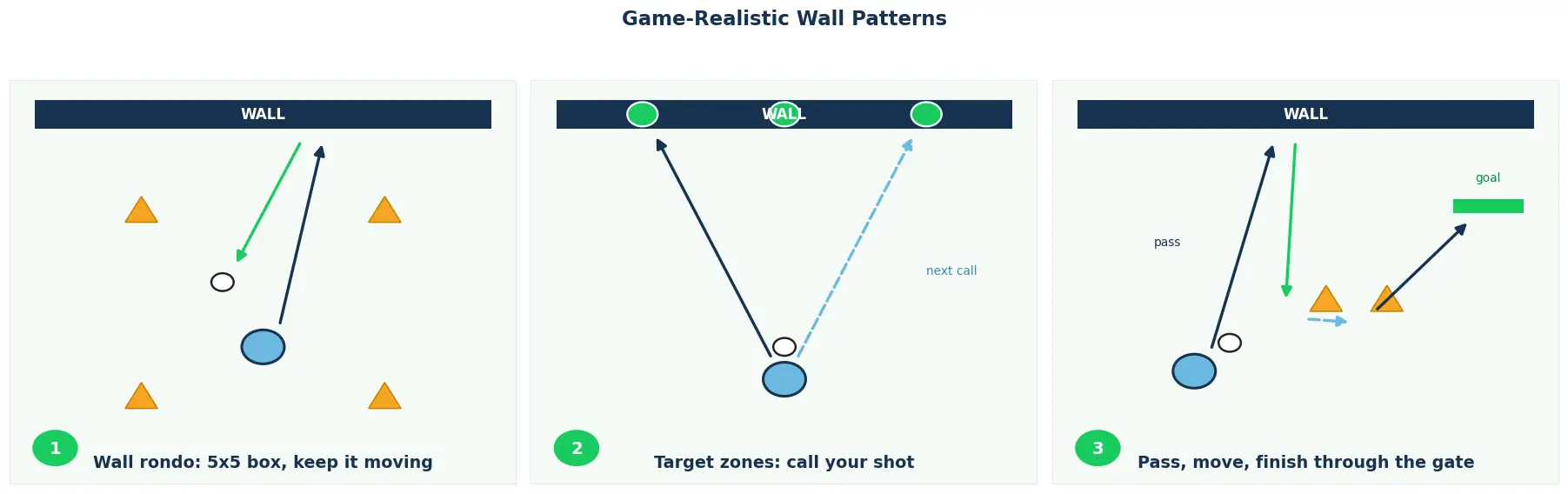
Drills build technique; games build players. These soccer practice games make wall work competitive enough that kids actually want to do it — which, as any parent knows, is half the battle.
Wall rondo (solo). Mark a 5×5-yard box with cones. Every pass must hit the wall and be received inside the box, and the ball can never stop moving. Three misses and you restart the clock. Survive 60 seconds, then shrink the box.
Target zones. Chalk three targets on the wall (or pick bricks): low left, low right, and one at chest height. Call the target before each pass. Score 10 hits, first touch counts as your setup. Add a sibling and alternate turns — misses are minus one, and it gets competitive fast.
Pass-move-finish. Pass against the wall, receive with a directional first touch, dribble through a two-cone gate, then finish into a target (a pair of cones, or the corner of the wall). This chains the whole game sequence — pass, receive, move, finish — into one rep.
Beat your record week. Log one number per session — rapid-fire count, target hits, rondo survival time. Improvement you can see on paper is the strongest motivator I’ve found for players in the 8-12 range, stronger than anything a coach says.
Your Weekly Wall Workout Plan
Here’s how I package it for the families I train:
| Day | Focus | Time |
|---|---|---|
| Monday | Basic patterns + cushion and kill | 12 min |
| Tuesday | Quick touch speed drills | 10 min |
| Wednesday | Rest or free play | — |
| Thursday | First touch drills + turn and play | 12 min |
| Friday | Soccer practice games (rondo, targets) | 15 min |
| Weekend | Pass-move-finish + record attempts | 15 min |
That’s about an hour a week. A player who follows this plan through a Columbus winter — garage, basement, school wall, anywhere — shows up in spring visibly sharper than teammates who only touched the ball at team practice. I’ve seen it every single year I’ve coached here.
Frequently Asked Questions
How far from the wall should my kid stand?
Start at 3-4 yards for two-touch work and 2-3 yards for one-touch. Closer means faster returns and quicker feet; farther means firmer passes and longer reaction time. Vary it — games don’t happen at one distance.
What surface and ball should we use?
Any solid wall without windows nearby: garage, basement, brick school wall, park handball court. A regular match ball works fine outdoors. For garage or basement sessions, a slightly deflated ball or futsal ball keeps the noise and rebound manageable.
My kid’s passes keep flying off at weird angles. What’s wrong?
Almost always an unlocked ankle or contact with the toes instead of the inside of the foot. Slow everything down, exaggerate the “toe up, heel down” position, and shorten the distance until passes come back clean. Speed is earned, not assumed.
Is a rebounder worth it if we have a wall?
If you have a good wall, start there — it’s free. The rebounder earns its money on aerial returns (walls send everything back on the ground), backyard convenience, and unpredictable bounces that mimic real play. Families in apartments or without a usable wall get the most value from the Rebounder Passing Net. (As an Amazon Associate, Soccercademy earns from qualifying purchases.)
How long until wall drills show up in games?
With 3-5 sessions a week, most players show a visibly calmer first touch in 2-3 weeks and noticeably faster passing decisions in 4-6. The one-touch speed work takes longest to transfer — but when it does, coaches notice immediately.
The Wall Is Waiting
Every Soccercademy player gets wall drills as homework because they work — more touches, honest feedback, zero excuses. If you want a second set of eyes on your kid’s technique, send me a video of their wall session and I’ll tell you exactly what to fix.
Get Personalized Drill Feedback — Book a Skills Session