
Most parents and coaches assume that any agility drill is good agility training. Run some ladder patterns, set up a few cones, repeat. But agility training in soccer is far more specific than that, and the difference between effective and ineffective methods shows up directly on the field. Recent science makes a clear case that reactive, decision-based training outperforms rehearsed footwork patterns for developing the kind of agility that actually changes game outcomes. This guide breaks down what the research says, which physical qualities matter most, and how youth players can build real soccer agility at home or at the club level.
Table of Contents
- What agility training in soccer actually means for youth players
- Reactive agility training vs planned drills: what the science says
- Key physical qualities that support agility in youth soccer players
- Practical drills and routines for youth agility training at home or club
- Common mistakes and expert tips to maximize agility gains safely
- Why most youth agility training misses the mark — and how to fix it
- Enhance your youth player’s soccer agility with expert training programs
- Frequently asked questions
Key Takeaways
| Point | Details |
|---|---|
| Agility includes reaction and decision-making | True soccer agility combines physical change of direction with cognitive skills like responding to game cues. |
| Reactive training enhances enjoyment | Reactive agility drills improve performance and player enjoyment, boosting training adherence. |
| Combine physical qualities | Explosive strength and flexibility complement agility drills for faster, safer directional changes. |
| Short, focused sessions work best | Weekly 15-20 minute agility blocks with varied drills maximize youth development without burnout. |
| Proper technique prevents injuries | Coach deceleration skills and gradual progression before advanced drills to minimize injury risks. |
What agility training in soccer actually means for youth players
To understand why agility training is so crucial, we first need to explore what agility truly means in the context of youth soccer. Most people think of agility as quick feet. That is only part of the picture.
Agility combines mechanical change of direction ability with perceptual and decision-making processes. In practical terms, this means a player must not only move fast but also read the field, anticipate an opponent’s next step, and commit to a direction before full information is available. That cognitive layer is what separates agility from simple speed or footwork.
For youth players specifically, developing this combination early builds habits that carry forward through every level of the game. A player who learns to react to visual cues at age 10 will process game situations faster at age 16. The soccer player development guide at Soccercademy outlines how these foundational skills compound over time.
The core components of agility in soccer include:
- Change of direction speed (CODS): The mechanical ability to decelerate, plant, and accelerate in a new direction
- Reactive agility (RA): Responding to an unpredictable stimulus, such as a defender’s body lean or a coach’s hand signal
- Spatial awareness: Processing where teammates, opponents, and the ball are simultaneously
- Balance and body control: Maintaining stability through sharp directional changes without losing speed
Each of these qualities can be trained. But not all drills train all of them equally.
Reactive agility training vs planned drills: what the science says
Understanding the difference between reactive and planned agility training helps clarify which exercises best develop soccer-specific skills.
Planned agility (PA) drills follow a fixed, predictable sequence. Think of a standard ladder pattern or a cone course where the player already knows the route. These drills build coordination and movement efficiency, but they do not challenge the brain to make decisions under pressure.
Reactive agility (RA) training introduces an unpredictable element. A coach points left or right at the last second. A light board flashes a color. A partner mirrors or breaks from a movement. The player must respond to that stimulus in real time, which is exactly what happens in a match.
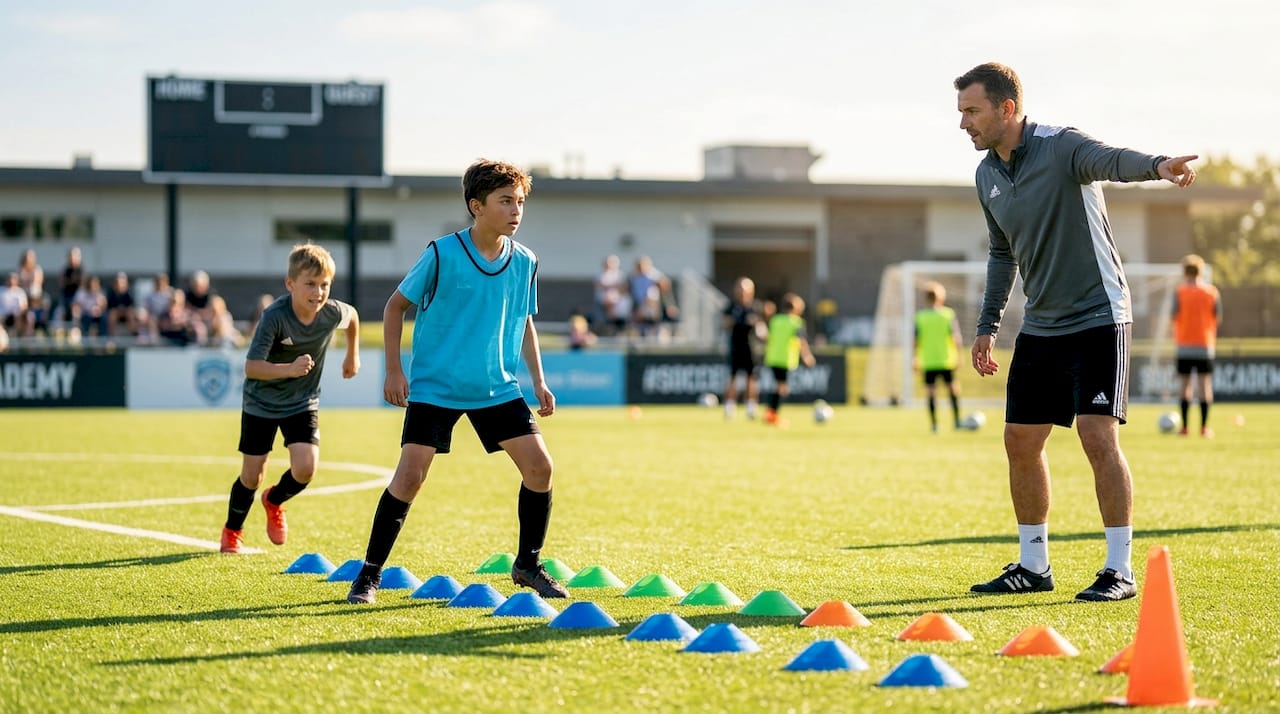
The performance difference is measurable. An 8-week reactive agility program improved reactive agility test times by 2 to 2.3% in under-16 soccer players compared to planned agility training, and players reported higher enjoyment without any additional physical exertion. That enjoyment factor matters enormously for youth athletes because it directly predicts how consistently they will show up and practice.
Reactive drills enhance decision-making by mimicking in-game cues, which leads to better engagement and stronger adherence to training over time.
| Training type | Decision-making demand | Game transfer | Player enjoyment | Coordination benefit |
|---|---|---|---|---|
| Planned agility drills | Low | Moderate | Moderate | High |
| Reactive agility drills | High | High | High | Moderate to high |
| Combined approach | High | Very high | High | High |
Pro Tip: You do not need expensive equipment to add reactive elements. A parent or coach standing at the end of a cone course and pointing left or right at the last moment turns a planned drill into a reactive one instantly.
Integrating neuromuscular agility training that combines both planned and reactive elements weekly gives youth players the coordination base of structured drills with the cognitive challenge of unpredictable stimuli.
Key physical qualities that support agility in youth soccer players
Along with training type, physical attributes like strength and flexibility play a crucial role in a young player’s agility.
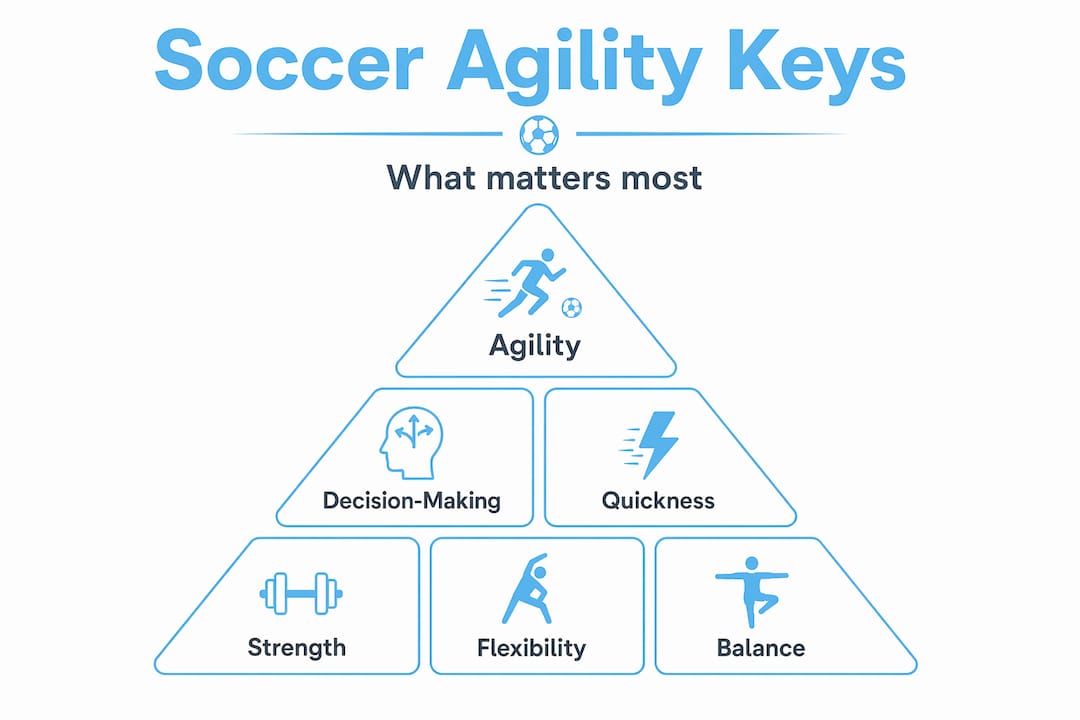
A 2026 longitudinal study of elite youth soccer players found that explosive strength correlates with faster change-of-direction performance, with standing broad jump distance serving as a reliable predictor of CODS scores. In other words, a player who can generate more force through the ground during a jump will also change direction faster during a sprint. These qualities share the same neuromuscular foundation.
Flexibility also contributes to agility, though its relationship to CODS is less direct. Greater hip and ankle mobility allows for deeper, more controlled plant steps during directional changes, reducing the time spent decelerating before re-accelerating.
Physical qualities youth players should develop alongside agility drills:
- Plyometric power: Box jumps, broad jumps, and single-leg hops build the explosive force needed for rapid direction changes
- Hip mobility: Dynamic stretches targeting the hip flexors and adductors support wider, more stable plant angles
- Ankle stability: Single-leg balance work and ankle circles reduce injury risk and improve ground contact efficiency
- Core control: A stable trunk allows the upper and lower body to work independently, which is critical during sharp cuts
For families training at home, combining two short plyometric exercises with each agility session is enough to build this physical foundation over a season. The strength training approach for soccer players differs from general athletic training, and understanding that distinction prevents wasted effort.
Practical drills and routines for youth agility training at home or club
Now that you know the science, here is how to put these insights into practice with drills designed for youth players’ development.
Veo coaching recommends 15-20 minute weekly agility blocks with 3 to 5 drills, prioritizing fun and gradual progressions for players ages 8 to 12. That is a manageable commitment for any family or club schedule.
A well-structured weekly agility session for youth players:
- Dynamic warm-up (3-4 minutes): High knees, lateral shuffles, and leg swings prepare the neuromuscular system before any cutting or sprinting
- Ladder footwork drill (4 minutes): Two-foot runs, lateral in-and-outs, or single-leg hops build coordination and foot speed
- Reactive cone drill (5 minutes): Set up four cones in a cross pattern; a coach or parent calls a color/number and the player sprints to that cone from center
- Mirror drill (4 minutes): Two players face each other 3 yards apart; one leads with lateral movements, the other mirrors; switch roles every 30 seconds
- Gate sprint (3 minutes): Place two cones 2 yards apart as a “gate”; player starts 5 yards back, receives a directional signal, and sprints through the correct side
| Drill | Age range | Equipment needed | Reactive element |
|---|---|---|---|
| Ladder footwork | U8 to U14 | Agility ladder | No (add coach signals to upgrade) |
| Reactive cone drill | U10 to U16 | 4 cones | Yes (coach calls direction) |
| Mirror drill | U8 to U16 | None | Yes (partner-driven) |
| Gate sprint | U10 to U16 | 2 cones | Yes (signal-based) |
For equipment, a durable sewn-rung ladder holds its shape better than flat plastic rungs during repeated use, which keeps spacing consistent and reduces tripping. You can review best soccer agility ladders to find options that hold up through daily backyard sessions.
Pro Tip: Always pair a dynamic warm-up protocol with agility sessions. Cold muscles and joints respond poorly to sharp directional changes, and a 3-minute warm-up is the single easiest injury prevention step a youth player can take.
Common mistakes and expert tips to maximize agility gains safely
To train effectively, it is important to avoid common mistakes and follow expert advice to stay safe and progress steadily.
The most consequential mistake in youth agility training is skipping deceleration mechanics. Building proper deceleration mechanics before plyometrics reduces knee and ankle injury risk in youth soccer players. A player who can sprint fast but cannot control a stop puts enormous stress on the ACL and ankle ligaments with every change of direction.
Teach soft landings first. When a player plants to change direction, the knee should bend, the hips should drop slightly, and the foot should strike mid-foot rather than on the heel or toe. This absorbs force across the entire kinetic chain rather than concentrating it at the joint.
Additional expert-backed guidelines for safe agility training:
- Limit session frequency: One dedicated agility session per week is sufficient for U12 and younger players; two sessions work for U14 and older when spaced at least 48 hours apart
- Monitor fatigue: Agility quality drops sharply when a player is tired; if reaction times are slowing and form is breaking down, end the session rather than push through
- Progress before adding speed: Master the movement pattern at controlled speed before demanding maximum effort; sloppy fast reps build bad motor patterns
- Avoid overusing fixed ladder patterns: Running the same ladder sequence every session trains coordination but not reactive agility; rotate patterns and add unpredictable signals regularly
Pro Tip: Film a short clip of your player during agility drills once a month. Comparing clips over a season reveals technique improvements and fatigue-related form breakdowns that are hard to catch in real time.
Why most youth agility training misses the mark — and how to fix it
Here is the uncomfortable reality: a large portion of youth agility training does not transfer to match performance, and the reason is predictability.
Many coaches overemphasize rehearsed ladder drills without reactive elements, which limits on-field transfer and reduces player enjoyment over time. A player who runs the same five-rung ladder pattern 200 times becomes very good at that specific pattern. But that pattern never appears in a game. What appears in a game is a defender closing from the right at an unexpected angle, a gap opening on the left with 0.3 seconds to exploit it, and a ball that takes an unpredictable bounce.
The fix is not to abandon structured drills. It is to treat them as a foundation, not a destination. Use planned drills to build coordination and movement vocabulary. Then layer reactive elements on top so the brain learns to apply those movements under pressure.
Enjoyment is not a soft metric here. It is a training variable. Youth players who find agility sessions engaging train more consistently, and consistency is what drives adaptation over a full season. A drill that is slightly less technically perfect but highly engaging will produce better results over six months than a perfect drill that players dread.
The third missing piece is multi-domain development. Agility is not purely a footwork skill. The neuromuscular approach to agility addresses strength, flexibility, and cognitive processing together, because all three systems contribute to how fast and accurately a player changes direction under match conditions. Treating agility as an isolated footwork skill leaves real performance gains untouched.
Enhance your youth player’s soccer agility with expert training programs
If you want your player to develop real, game-ready agility, the structure of their training matters as much as the effort they put in. At Soccercademy, we work with youth soccer players in Columbus, Ohio, and we are building structured youth soccer training programs that bring evidence-based agility and speed development to players at every level.

Our programs integrate injury prevention warm-up routines and neuromuscular speed training into every session so players build agility safely and progressively. Whether your player trains with us locally or through our upcoming on-demand video membership, every program follows the same science-backed principles outlined in this guide. Structured guidance removes the guesswork and gives youth players a clear path to consistent improvement on the field.
Frequently asked questions
What is the difference between reactive and planned agility training?
Reactive agility training requires responding to unpredictable cues like a teammate’s movement or a coach’s signal, while planned agility drills follow fixed patterns the player already knows. Reactive training better simulates game situations and builds decision-making speed, with reactive agility showing 2-2.3% faster test times and higher enjoyment than planned training in youth soccer players.
How often should youth soccer players practice agility drills?
One dedicated 15-20 minute agility session per week integrated into regular practice is sufficient to build agility qualities over a full season. Veo coaching recommends one weekly agility block with 3 to 5 drills for U8 to U14 players, keeping sessions short and focused.
Are agility ladders effective for soccer training?
Yes, agility ladders improve footwork, coordination, and rhythmic timing, but they should be combined with reactive drills for true soccer agility development. Agility ladders condition the CNS and coordination effectively but require added reactive stimuli to transfer to match performance.
What physical qualities support better agility besides agility drills?
Explosive strength and flexibility significantly support change-of-direction speed in youth players, making plyometric and mobility work essential complements to agility training. Standing broad jump distance moderately correlates with faster change-of-direction times in elite youth soccer players.
How can youth players avoid injuries during agility training?
Youth players should learn proper deceleration mechanics with soft, controlled landings before progressing to plyometrics or high-speed reactive drills. Deceleration training with soft landings reduces ACL and ankle injury risk in youth agility training, making it the most important foundational skill to establish first.
Recommended
- Train your Players to Level Up! – Pavel shows soccer players step by step how to progress all aspects of your soccer game with training and play with the confidence you want on the field
- Developing Elite Soccer Speed: The Neuromuscular Approach – Train your Players to Level Up!
- Evidence-Based Guide to Game-Day Nutrition for Soccer Players – Train your Players to Level Up!
- Dynamic Warm-Up Protocols That Actually Prevent Soccer Injuries – Train your Players to Level Up!
Article generated by BabyLoveGrowth
Gear I recommend for this: grab an agility ladder and hurdles from the Soccercademy store. (As an Amazon Associate, Soccercademy earns from qualifying purchases.)