
Key Points
| Best For | Youth soccer players ages 10-18 in Ohio looking to reduce injuries and improve performance |
| Time Needed | 10-30 minutes, 2-4x per week alongside regular training |
| Key Benefit | Yoga improves flexibility, balance, mental focus, and recovery — all at once |
| Common Mistake | Treating yoga as “just stretching” — it’s a full neuromuscular training tool |
| Coach’s Take | The players who recover smartest, last longest. Yoga is part of how I keep my athletes healthy. |
I’ll be honest with you: when I first started incorporating yoga into my training philosophy, I got some looks. Soccer parents in Columbus weren’t sure what downward dog had to do with their kid’s first touch or defending ability. But the results spoke for themselves — and the research has caught up to what I was seeing on the field.
Yoga isn’t just flexibility work. It’s a training method that develops balance, body awareness, mental composure, and injury resilience all at the same time. For youth soccer players competing in Ohio’s increasingly competitive club and academy landscape, that combination is invaluable. The kids who can stay healthy through a full season, recover between back-to-back games, and keep their composure when the pressure is on — those are the kids who make the jump to the next level.
This guide breaks down exactly why yoga matters for soccer players, how it compares to traditional stretching, and how to build it into a training schedule without overloading your kid.
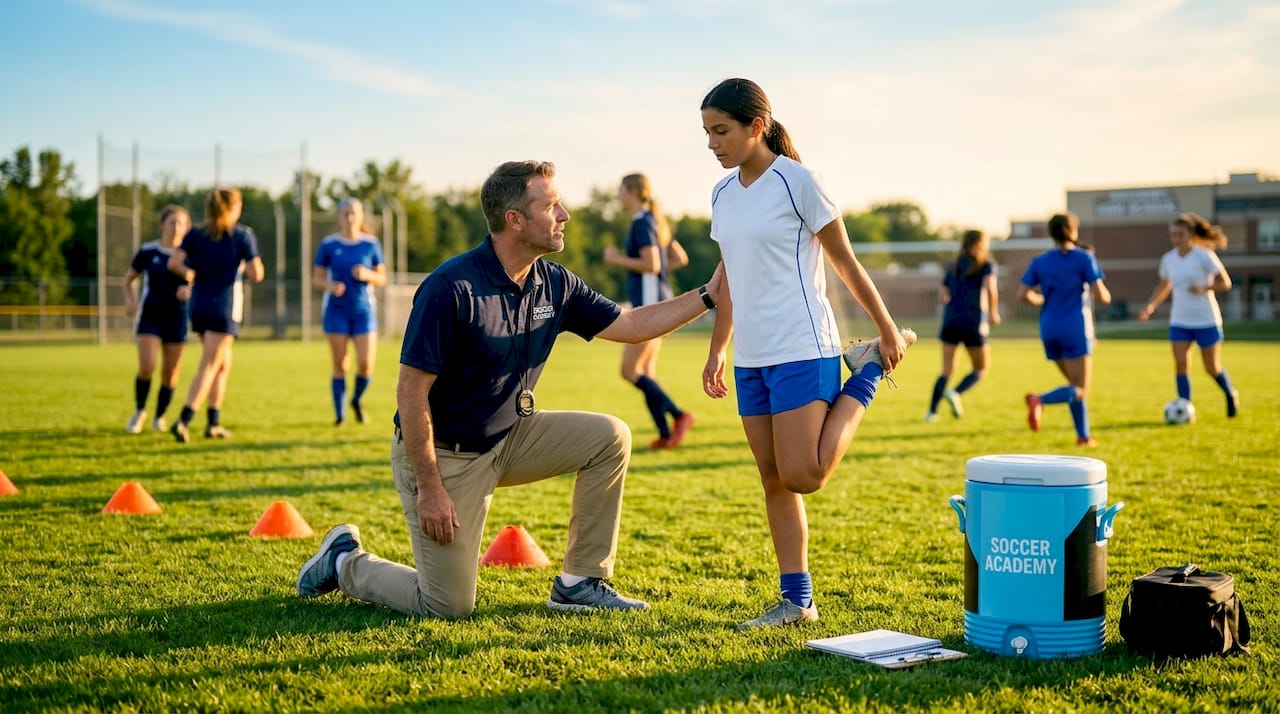
Why Yoga Gives Soccer Players an Edge Most Training Doesn’t
Soccer training tends to focus on what’s obvious: technical skills, tactical understanding, and physical fitness. Those are all essential. But there’s a layer underneath that most programs ignore — the neuromuscular system, proprioception, and the mental game. Yoga addresses all three in ways that traditional training simply doesn’t.
Here’s what I see consistently with the players I train at Soccercademy who incorporate yoga into their routine:
Better single-leg balance. Soccer is a single-leg sport — you shoot, pass, and change direction on one foot. Yoga poses like tree pose and warrior III build the stabilizing muscles around the ankle, knee, and hip that keep players balanced during these movements. The result is fewer rolled ankles and more confident play on the ball.
Improved hip flexibility. Tight hip flexors are epidemic among youth soccer players, especially those who sit in school all day and then train in the evening. Tight hips limit stride length, reduce shooting power, and set the stage for groin pulls. Yoga systematically opens the hips in ways that static stretching alone doesn’t match.
Faster recovery between sessions. This is the one parents underestimate the most. A 15-minute yoga session after training helps flush metabolic waste from the muscles, reduces delayed-onset muscle soreness, and prepares the body for the next day’s work. Players who recover well train better — and players who train better improve faster. It’s a compounding advantage.
Mental composure under pressure. Breathwork and mindfulness aren’t just buzzwords. Research consistently shows that yoga reduces sports anxiety and improves focus in young athletes. I’ve seen it firsthand: the player who does a breathing exercise before penalty kicks handles the moment differently than the one who’s all adrenaline and no control.
Yoga vs. Traditional Stretching: What’s Actually Better for Soccer?
This is a question I get from parents constantly, and the answer is nuanced. It’s not that one is better — it’s that they serve different purposes, and the timing matters enormously.
| Method | Best Timing | Primary Benefit | Impact on Performance | Recovery Effect |
|---|---|---|---|---|
| Dynamic Stretching | Before training | Neuromuscular activation | Positive — primes speed and agility | Moderate |
| Yoga Flows | Before or after training | Flexibility, balance, mental focus | Positive long-term | High |
| Static Stretching | After training only | Range of motion | Negative if done before exercise | Moderate |
| Restorative Yoga | Rest days | Deep recovery, mental reset | Positive — reduces overtraining risk | Very high |
This is something I’ve been coaching for years — the active-before, passive-after principle. American youth soccer had it backwards for a long time. Teams were doing static stretches before games, which actually weakens muscle power temporarily, and then skipping recovery work entirely after training. The science is unambiguous now: dynamic movement and yoga-based activation before play, static holds and restorative work after.
Where yoga has the edge over traditional stretching alone is the combination of benefits. A static hamstring stretch improves hamstring range of motion. A yoga flow that includes the same hamstring work also engages the core, challenges balance, involves breath control, and builds body awareness — all in the same amount of time. It’s a more efficient use of those recovery minutes.
How Yoga Prevents the Injuries That Sideline Youth Players
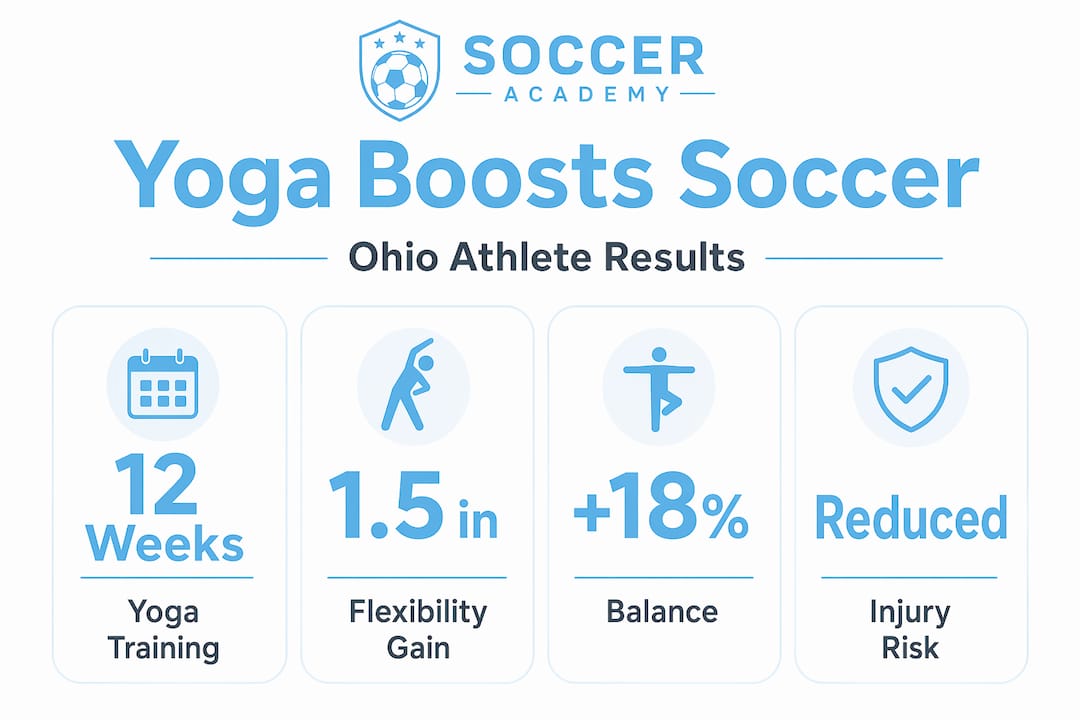
Research on yoga for athletes shows measurable physical improvements within 12 weeks of consistent practice: better flexibility, improved balance, and greater joint mobility across multiple measurements. For youth soccer players, those gains translate directly into fewer injuries during the season.
Here are the injury-prevention benefits I see most often with my Soccercademy athletes who do yoga:
Reduced hamstring pulls. Tight hamstrings are the most common complaint I hear from youth players, and they lead to strains that can sideline a kid for 2-4 weeks. Yoga’s progressive hip and hamstring work addresses the root cause — not just the symptoms.
Fewer ankle sprains. Balance-focused poses build the proprioceptive system that helps players react when they land on an uneven surface or get their ankle caught in a tackle. A stronger proprioceptive system means the ankle corrects faster, reducing the severity of sprains.
Less knee pain. IT band tightness and weak hip abductors are the silent drivers of knee issues in young runners and soccer players. Yoga addresses both, strengthening the muscles that protect the knee from the valgus collapse that causes so many ACL injuries.
Lower back protection. Youth players who play multiple games per weekend often develop lower back tightness and pain. Yoga’s spinal mobility work — cat-cow, child’s pose, spinal twists — directly addresses this, and players report feeling looser and more comfortable within weeks.
The compounding effect matters here. A player who gains even small improvements in flexibility and balance early in the season is moving with less mechanical resistance on every sprint, every cut, every shot for the rest of the year. Those small gains prevent the accumulated stress that leads to overuse injuries by October.
The Mental Game: Why Yoga Matters Beyond the Physical
This is the part that surprised me most when I started seeing yoga’s impact on my players. The physical benefits were expected — of course better flexibility helps a soccer player. But the mental shift was something else entirely.
Youth soccer in Ohio is intense. Between ECNL, MLS Next, Premier League, and ODP, kids are playing 60-80 competitive matches a year by age 13. That’s a lot of pressure — pressure to perform, pressure to impress college scouts, pressure to justify the investment their families are making. And most of these kids have zero tools for managing that mental load.
Yoga gives them those tools. The breathwork component — learning to control your breathing under stress — transfers directly to game situations. The mindfulness aspect — being present in the moment instead of worrying about the last mistake or the next play — is exactly what sports psychologists teach, just delivered through movement instead of a lecture.
Specific mental benefits I’ve observed in players who incorporate yoga:
Pre-game composure. Players who do a 5-10 minute breathing and movement routine before matches report feeling calmer and more focused. They’re not eliminating nervousness — some nerves are healthy — but they’re channeling it instead of being overwhelmed by it.
Faster emotional recovery. Every player makes mistakes during a match. The ones who bounce back quickly — who can let go of a missed shot or a bad pass and refocus on the next play — are the ones who perform consistently. Yoga builds exactly this capacity.
Better body awareness for tactical decisions. This one’s subtle but important. Players who have developed strong proprioception through yoga are more aware of where they are on the field, where their teammates are, and what their body can do in any given moment. That awareness feeds directly into better decision-making during play.
A Practical Yoga Plan for Ohio Youth Soccer Players
The key to making yoga work for a soccer player is integration — it should complement training, not compete with it. Here’s the weekly plan I recommend to Soccercademy parents:
Monday (pre-training, 10 min): Dynamic yoga flow. Sun salutations, warrior sequences, and hip-opening movements. This serves as both a warm-up activation and a flexibility builder. Pair it with your dynamic stretching routine and you’ve got a complete pre-session protocol.
Wednesday (post-training, 15-20 min): Recovery-focused static yoga. Hold each pose for 30-45 seconds. Focus on the areas that take the most abuse during soccer: hip flexors, hamstrings, calves, thoracic spine, and shoulders. This is the session that reduces soreness and keeps the body ready for the next day.
Friday (pre-match, 10 min): Light movement with breathwork. This isn’t about deep stretching — it’s about getting the body ready and the mind focused. Gentle flows, controlled breathing, and mental visualization of the match ahead.
Sunday (rest day, 20-30 min): Full restorative session. Deep hip openers, spinal mobility, long holds, and extended breathing work. This is the session that pays dividends all week, and it’s the one most families skip because there’s no ball involved. Don’t skip it.
Start with 10-minute sessions if your kid is new to yoga. Consistency over 8-12 weeks is what produces the measurable gains that research documents. Three short sessions per week beats one long session — the body adapts to frequent, moderate stimulus better than occasional intensity.
Frequently Asked Questions
How often should youth soccer players practice yoga?
Two to four short sessions per week, ranging from 10 to 30 minutes each. The key is consistency — regular practice produces compounding benefits. I recommend starting with two sessions and building to four as the habit develops. Even on weeks with heavy match schedules, maintaining at least one recovery yoga session makes a noticeable difference.
Does yoga actually reduce the risk of soccer injuries?
Yes. Research shows measurable improvements in flexibility and balance after 12 weeks of consistent practice. Those improvements translate directly to fewer muscle strains, ankle sprains, and overuse injuries during the season. It’s not a guarantee — nothing is — but players who maintain yoga alongside their training get hurt less often than those who don’t.
Can yoga help with pre-game nerves?
Absolutely. The breathwork and mindfulness components of yoga are specifically effective for managing sports anxiety. Studies on young athletes confirm that yoga reduces negative emotions and improves psychological flexibility. I’ve seen this play out countless times with my players — the ones who use breathing techniques before matches handle pressure situations significantly better.
What’s the difference between yoga and just doing flexibility exercises?
Flexibility exercises target range of motion in specific muscles. Yoga does that too, but it also engages the core, challenges balance and proprioception, includes breath control, and develops body awareness — all simultaneously. Think of it as flexibility plus neuromuscular training plus mental conditioning, delivered in a single practice. It’s a more efficient use of your kid’s limited training time.
My kid thinks yoga is boring. How do I get them to try it?
Start with the athletic poses that feel like training — warrior sequences, balance challenges, core holds. Skip the meditation and chanting. Frame it as “what the pros do to stay healthy” rather than “yoga.” Many of my players were skeptical at first but got hooked once they felt the difference in how their body moved on the field. The results sell it better than any pitch.
Train the Whole Athlete — Not Just the Soccer Player
At Soccercademy, recovery and injury prevention are built into every training plan. Your kid deserves coaching that develops their body and mind — not just their ball skills.
Gear I recommend for this: grab resistance bands and a foam roller from the Soccercademy store. (As an Amazon Associate, Soccercademy earns from qualifying purchases.)