
Choosing the right summer soccer camp for your child is harder than it looks. The options in Columbus alone range from recreational day programs to high-intensity club sessions, and without a clear soccer summer camp skills checklist in hand, parents risk signing up for a camp that either overwhelms their player or fails to challenge them. This article gives you a practical, expert-backed framework covering selection criteria, age-appropriate skills to develop, gear to pack, and how to evaluate camp formats so your child walks in prepared and walks out better.
Table of Contents
- Key criteria for selecting and preparing your child for a soccer summer camp
- Essential soccer skills checklist for youth summer camps
- Comprehensive gear and packing checklist for soccer summer camps
- Comparing youth soccer summer camp types and formats for Columbus families
- Pro tips for maximizing your child’s development at soccer summer camps
- Why matching camp style to your child’s personality beats focusing on prestige
- Continue your child’s soccer skill journey with tailored training resources
- Frequently asked questions
Key Takeaways
| Point | Details |
|---|---|
| Age-appropriate training | Ensure the camp groups players by age and skill to tailor instruction effectively. |
| Skill focus | Prioritize ball mastery and small-sided games to build confidence and soccer IQ. |
| Essential gear | Bring cleats, shin guards, the correct ball size, water, and sunscreen daily. |
| Camp type matters | Match camp format to your child’s maturity, skill, and personality for the best experience. |
| Coach ratio | Look for low coach-to-player ratios like 1:12 for individualized attention. |
Key criteria for selecting and preparing your child for a soccer summer camp
Before your child touches a ball at camp, the structure behind the program matters enormously. Two factors predict learning quality above nearly all others: how players are grouped and how many coaches are available per player.
Classic Skill Camps group players by age and skill on day one and maintain a 1:12 coach-to-player ratio for individualized training. That ratio is not arbitrary. At 1:20 or higher, coaches shift from coaching to crowd management, and your child gets a fraction of the technical feedback they need to actually improve.
Safety protocols are equally non-negotiable. Look for programs where coaches hold CDC concussion training certification and have passed background checks. Head injuries in youth sports are underreported precisely because players push through early symptoms, making staff education a frontline protection.
“The right camp isn’t the most expensive one. It’s the one where your child is grouped correctly, coached closely, and protected properly.”
Criteria to evaluate before registration:
- Age and skill grouping practiced on day one, not just promised in marketing
- Coach-to-player ratio at or below 1:12
- Staff background checks and concussion protocol training
- Mandatory equipment requirements (cleats, shin guards, correct ball size)
- Clear physical form and medical waiver requirements communicated before camp starts
Steps to prepare your child before the first day:
- Confirm your child’s skill group matches the camp’s intake criteria
- Purchase properly sized equipment at least one week in advance so your child can break in cleats
- Complete all physical forms and waivers before camp, not the morning of
- Review training progression tips with your child so they arrive with context, not confusion
- Schedule a brief nutrition conversation using game-day nutrition guidance so energy levels stay consistent across multi-hour sessions
You can find a solid example of these standards in action at the Garden Grove Soccer Camp, which publishes its grouping and safety policies publicly. Using that as a benchmark when evaluating Columbus-area programs is a practical starting point.
Essential soccer skills checklist for youth summer camps
A reliable skills assessment for soccer camp starts with understanding what is developmentally appropriate at each age band. Packing the wrong expectations into a 7-year-old’s week is just as counterproductive as under-challenging a 12-year-old.
For younger players ages 6 to 9, 70% of training should focus on ball mastery through chaotic, game-based drills that maximize touches and keep the experience enjoyable. Ball mastery means the player can receive, control, and move a ball under light pressure without needing to look down at their feet. It is the neurological foundation that every other skill is built on. Repetition through play, not repetitive lines, is what creates that automaticity.
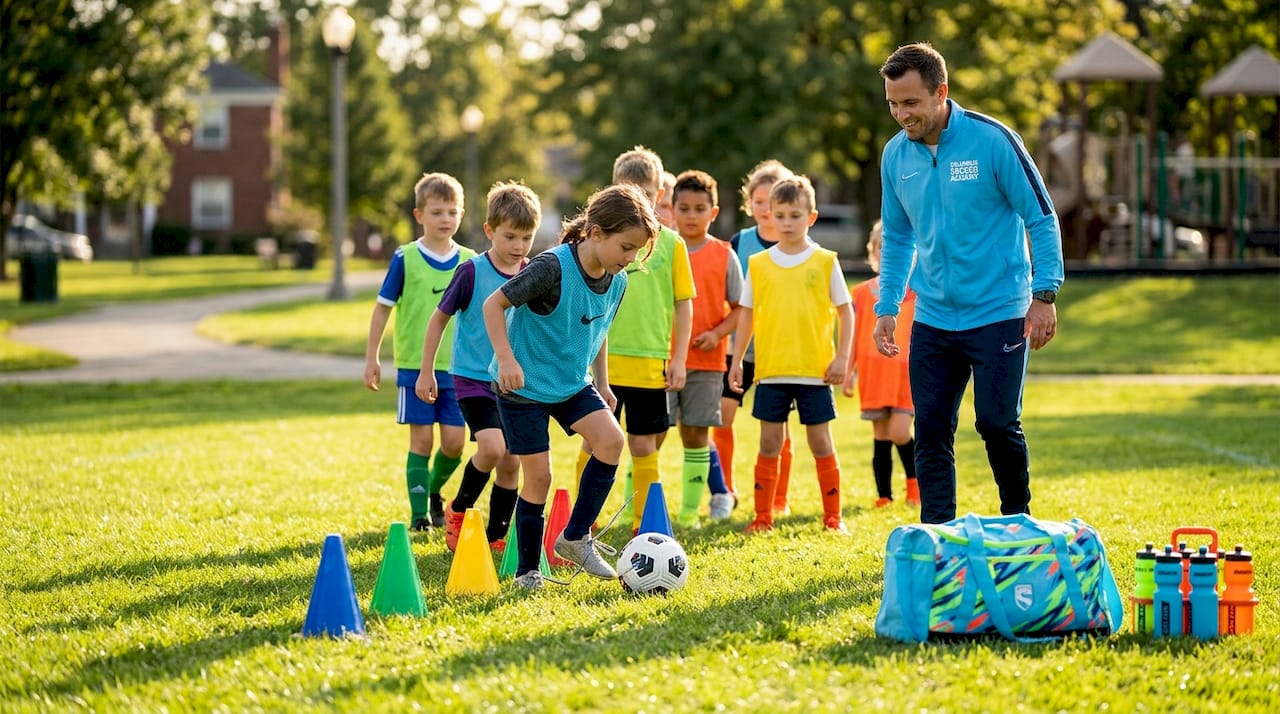
For players ages 9 to 12, blending ball mastery with small-sided games develops soccer IQ without overwhelming the player. Small-sided games, typically 3v3 to 5v5, force faster decisions and more frequent ball contact than full 11v11 play. A player can touch the ball 30 times in a 10-minute small-sided game and fewer than 10 times in the same duration of full-sided play.
Soccer summer camp skills checklist by age group:
Ages 6 to 9 (foundational):
- Ball control with both feet in stationary and moving situations
- Basic dribbling with speed changes and direction cuts
- Receiving a rolling or bouncing ball without losing possession
- Understanding personal space and basic positioning
- Kicking with the instep and inside of the foot with reasonable accuracy
Ages 9 to 12 (developing):
- Consistent first touch under light pressure
- Passing with weight and accuracy to a moving target
- Tracking runs and positional awareness in small-sided formats
- Basic 1v1 defending (body position, patience, delaying)
- Shooting with the laces from inside the penalty area
- Communication and decision-making in game scenarios
Ages 12 and up (competitive):
- Combination play with give-and-go sequences
- Transitional awareness (switching from defense to attack immediately)
- Set piece understanding and basic tactical roles
- Physical conditioning to maintain technique under fatigue
Pro Tip: Before camp starts, run your child through two or three age-appropriate soccer drills at home. Even 15 minutes of dribbling around cones in the driveway removes the first-day anxiety that prevents many kids from learning effectively on day one. Confidence and competence are directly linked in youth development. You can also explore resources on developing soccer speed to build the physical base that makes technical skills more effective.
Comprehensive gear and packing checklist for soccer summer camps
What you bring to camp affects how much your child can participate, recover, and stay focused. Missing one item can sideline a player or create unnecessary discomfort during what should be their best training week of the year. Here is a complete packing guide based on youth soccer camp requirements published by established programs.
Daily essentials (non-negotiable):
- Soccer cleats or firm-ground athletic shoes (cleats preferred for field traction)
- Age-appropriate soccer ball: size 3 for ages 4 to 8, size 4 for ages 9 to 11
- Shin guards that fit correctly inside socks, covering the full shin
- Full water bottle, minimum 24 oz, plus refill access for every 20 minutes of activity
- Sunscreen applied before arrival and packed for reapplication at midday
- Light snack for mid-session energy (banana, crackers, or a granola bar)
- Change of socks in case of wet conditions or blisters
- Completed physical form and medical waiver in a sealed envelope
Additional items that prevent common problems:
| Item | Why it matters | Common mistake |
|---|---|---|
| Vaseline or body glide | Prevents heel and toe blisters in new cleats | Skipped until too late |
| Permanent marker label on all gear | Prevents mix-ups in large groups | Unlabeled ball gets lost day 1 |
| Cooling towel or small ice pack | Reduces heat fatigue between sessions | Forgotten in summer heat |
| Backup shin guard straps | Straps break mid-session frequently | No replacement available on-site |
| Light rain layer | Columbus summer weather is unpredictable | Left behind on a drizzly day |
Players should label all gear permanently, bring Vaseline for blister prevention, and pack enough water to drink every 20 minutes across the full session length. This is not excessive preparation. A player who is blistered or dehydrated by day two loses 60 to 80 percent of the training benefit for the remaining days.
Pro Tip: Visit nutrition and hydration tips before camp week and plan your child’s breakfast and pre-camp snack accordingly. Players who arrive with stable blood sugar levels engage more quickly and fatigue more slowly, which translates directly into faster skill acquisition.
Comparing youth soccer summer camp types and formats for Columbus families
Not every camp format suits every player. The table below breaks down the most common structures so you can match the format to your child’s age, competitive level, and temperament.
| Camp type | Best for | Intensity | Typical duration | Key benefit |
|---|---|---|---|---|
| Recreational day camp | Ages 6 to 10, beginners | Low to moderate | Half to full day | Fun, social, foundational |
| Club training camp | Ages 9 to 14, club players | Moderate to high | Full day | Team cohesion, position work |
| Pro-branded camp | Ages 10 and up, motivated players | High | Full day | Exposure to advanced tactics |
| Residential camp | Ages 13 and up, independent players | Very high | Multi-day overnight | Total immersion, accelerated gains |
Recreational day camps suit younger or newer players best, with shorter days and an emphasis on fun and basic skills. These programs succeed because they reduce pressure and increase enjoyment, which drives long-term participation. A child who has fun at their first camp is far more likely to keep playing through adolescence.
Residential camps provide total immersion and faster technical development but require a level of maturity and independence that most players under 13 do not yet have. Sending a child who is not ready can result in homesickness and anxiety that actively prevents learning.
Questions to ask before choosing a format:
- Does your child want intensity or fun as the primary outcome?
- Is this their first camp or their fifth?
- Can they manage a full day away from home comfortably?
- Does the coach-to-player ratio hold across the full session?
Browse youth camp formats explained to explore how different structures map to different development stages.
Pro tips for maximizing your child’s development at soccer summer camps
The difference between a child who improves significantly at camp and one who plateaus often comes down to preparation and follow-through, not talent. These tips are drawn from direct observation of high-performing youth programs.
Pre-camp daily 15-minute dribbling and passing builds confidence without creating burnout before camp even starts. Short, consistent home sessions remove the awkwardness of handling the ball in front of peers, which is a barrier many kids never name but clearly experience.
High-impact preparation and during-camp habits:
- Arrive 10 to 15 minutes early on day one so your child acclimate before formal drills begin
- Discuss one specific skill goal with your child before each session, not five
- Ask your child after each day what one thing a coach told them. Writing it down reinforces retention
- Watch for fatigue signs: dragging feet, poor concentration, or complaints of shin pain after day two
- Avoid intensive weekend sports activities during camp week to protect recovery capacity
- Consider adding strength training for young players in the weeks before camp to improve physical readiness
“Camp week is a sprint. The prep work you do in the two weeks before it determines how much your child can absorb once they’re there.”
Also, help your child understand what they are working toward. A player who knows they are building first-touch accuracy trains with different focus than one who is just running drills. Intentional practice accelerates skill acquisition measurably, even in short camp sessions.
Why matching camp style to your child’s personality beats focusing on prestige
Here is something most camp guides will not tell you directly: the reputation of a camp matters far less than whether its environment fits your child’s temperament.
Some kids thrive in competitive, high-structure environments, while others need a lighter, relationship-driven setting to stay confident and engaged. A socially anxious 9-year-old placed in an elite camp full of U11 club players is not going to absorb technical instruction, regardless of how qualified the coaching staff is. Stress and learning operate in opposite directions in the developing nervous system.
The parents who make the best camp decisions are the ones who watch their child play pick-up soccer first. Is your child highly competitive, self-motivated, and unfazed by failure? Or do they thrive on positive reinforcement, prefer collaboration, and disengage when the stakes feel too high? Both profiles are valid. Both require completely different camp environments.
Chasing brand-name camps because other parents recommend them is one of the most common mistakes in youth soccer development. A camp is only as good as the daily interaction between a coach and your child. An unknown local program with a 1:8 ratio and genuinely skilled coaches will produce better outcomes than a high-profile program where your child is one of 25 players sharing a single coach.
Our players development approach at Soccer Cademy is built around this exact principle: the right environment for each athlete produces more growth than the highest-prestige environment regardless of fit. Evaluate camp culture the same way you evaluate a school, because the developmental stakes are the same.
Continue your child’s soccer skill journey with tailored training resources
Your child’s development should not pause when camp week ends. The skills introduced at camp need reinforcement, repetition, and progression through the rest of the year to become permanent.

At Soccer Cademy, we have built a platform specifically for Columbus youth players and their families. Our soccer training resources include step-by-step player development programs that align directly with what your child learns at camp, so the momentum does not stop on Friday afternoon. Through our membership levels overview, parents can access on-demand training videos, age-specific drills, and expert guidance matched to their child’s current stage of development. You can also equip your player properly through our training gear and tools store, stocked with everything from appropriate ball sizes to training aids. Consistent off-season development is what turns a good camp week into a lasting performance shift.
Frequently asked questions
What is the right soccer ball size for my child’s summer camp?
Children ages 4 to 8 should bring a size 3 ball, while ages 9 to 11 need a size 4 ball to match camp requirements and support proper skill development at each stage.
How important is the coach-to-player ratio at summer camps?
A ratio of 1:12 or lower, as seen in Classic Skill Camp formats, ensures each player receives meaningful individual feedback rather than generic group instruction throughout the session.
What essentials should my child bring every day to camp?
Daily essentials include cleats, the correct ball size, shin guards, adequate water, sunscreen, and labeled gear, all of which directly affect safety and training participation.
Are overnight soccer camps appropriate for young children?
Overnight camps require maturity and independence that most players under 13 are still developing; younger players typically benefit more from day camp formats with shorter hours and familiar surroundings.
How can I ensure my child stays hydrated during long camp days?
Pack enough water for every 20 minutes of activity alongside light energy snacks, and encourage your child to drink proactively rather than waiting until they feel thirsty, which is already a sign of early dehydration.
Recommended
- Train your Players to Level Up! – Pavel shows soccer players step by step how to progress all aspects of your soccer game with training and play with the confidence you want on the field
- Dynamic Warm-Up Protocols That Actually Prevent Soccer Injuries – Train your Players to Level Up!
- Evidence-Based Guide to Game-Day Nutrition for Soccer Players – Train your Players to Level Up!
- Why Soccer Players Need Different Strength Training Than Other Athletes – Train your Players to Level Up!